Hitting well
A shot in Pelota is good when three things come together: where you stand, when you release the button and how much time the ball gives you. This page is the player’s guide; Hitting the ball explains the same things from the inside.
1. Stand in the right place
When your opponent hits, a marker appears at your feet: a ring at the standard spot to meet the ball, and a line through it. The line is the range of places you can take the ball from, from early (closer to the net) to late (further back). The marker is red when you are far off and turns green when you stand on the line.
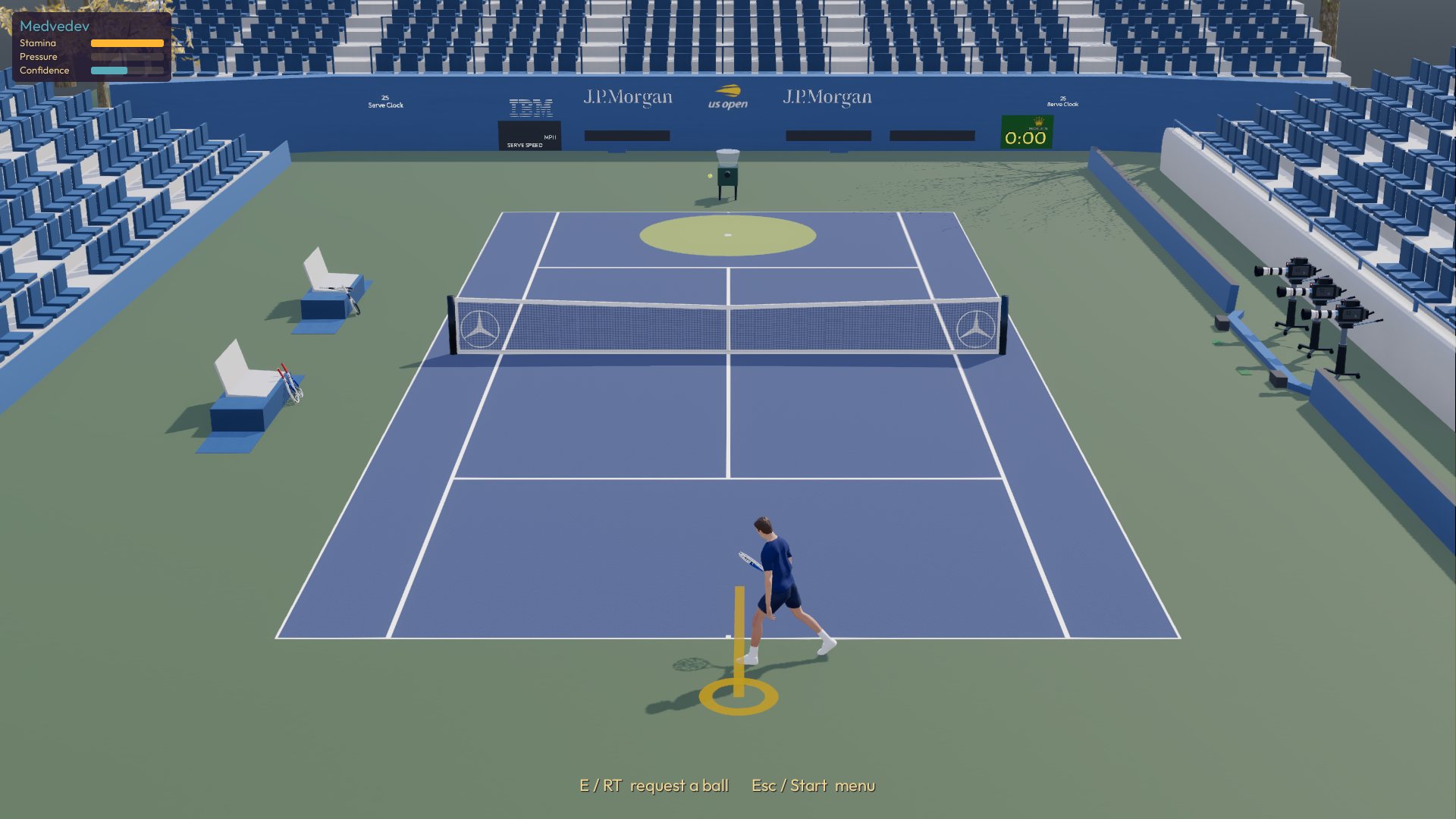
Once you press the shot button, your player only jogs. So do the running yourself, and press the button when you are (nearly) there.
Early or late? Your choice
Where on the line you stand decides how you take the ball:
- Step in and you take the ball early, on the rise. You borrow pace from your opponent’s ball and give them less time, but the timing is harder (the perfect window is shorter) and you risk a little control.
- Stay back and you take it late, as it drops low. The timing is easier and safer, but the shot has less bite.
A normal groundstroke never needs more than about a meter of moving back. If the ball bounces deep and high, step in rather than chasing it back: you take it higher, but on time.
2. Release at the right moment
Release the shot button just before the racket meets the ball. Within the last ~0.12 seconds (longer for players with good timing, shorter when you take the ball early) your timing is perfect. Release earlier and the shot loses accuracy, pace and spin step by step.
A perfect release is worth a lot. Compared with a release just outside the perfect window, a perfect shot gets:
- full pace: the shot keeps all of its speed (92% when just outside the window), and its attacking pace is doubled;
- much more spin: 130% instead of about 105%;
- far more precision: the landing area shrinks from about 0.9 m to 0.25 m.
While you hold the button, the landing ring on the far side shrinks as your timing gets better and lights up when a release would be perfect. Watch it!
3. Use the time the ball gives you
The full attacking pace only comes through when you were set early (standing still for a moment before contact) and the ball gave you time. A hard, fast ball or a deep ball near your baseline rushes you: those shots come back with less pace and less control, whatever you do. Against such balls, play safe and deep; attack the short and slow ones.
The rating above your player
After each shot a word appears above your player:
| Rating | What it means |
|---|---|
| PERFECT! | Perfect timing and the ball in the racket’s sweet spot |
| GREAT / GOOD | Both timing and position were fine |
| EARLY | You released the button too early |
| LATE | You were still holding the button at contact |
| OUT OF POSITION | You were too far from the ball |
The worse of timing and positioning decides the rating, and its name tells you which one to work on.