Movement
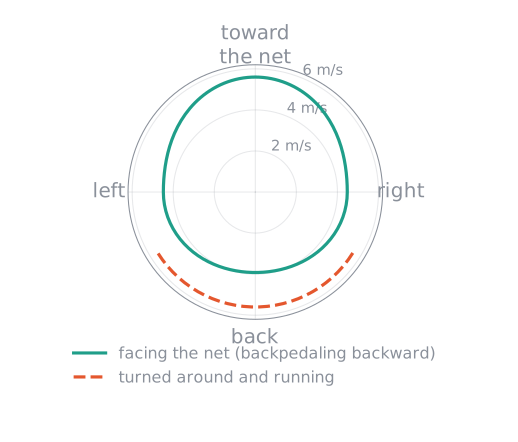
Short version: players run fastest toward the net, a bit slower sideways and slowest when backpedaling while still facing the net. For more than a step or two back they turn around and run, and then they are fast again. They speed up and slow down like athletes: a 5 m sprint takes about a second.
Speed and acceleration
| Average player | |
|---|---|
| Top speed toward the net | 5.6 m/s (20 km/h) |
| Sideways | 80% of it |
| Backpedaling (facing the net) | 70% of it |
| Acceleration | 11 m/s² |
The player’s stats scale these values: top speed from 85% to 120%, acceleration and agility together from about 70% to 140%. Stamina lowers them as the player tires (see Stamina and player stats).
Changing direction sharply (more than about 30°) costs acceleration for a short moment. Agile players lose less.
Arriving at a target, the player brakes in time to stop there instead of overshooting. The target speed is never more than the speed from which they can still stop at 8 m/s².
Backpedaling or turning around
Moving backward faster than 3.5 m/s, within about 60° of straight back, the player turns around and runs. Below 2.8 m/s they face the net again and backpedal. So a step or two back to meet a ball (which peaks at about 3 m/s) is backpedaled, and a long run back for a lob is a real turn-and-run.
The body turns, but the player’s “front” for the strokes stays toward the net: when a stroke starts, the body snaps back to face the net, so the swing meets the ball where it should.
Getting to the ball
When the opponent hits, the controller looks at the ball’s predicted flight and picks where to meet it (see Hitting the ball). From there it knows where the player must stand, so that the stroke’s contact point lands on the ball. For every possible meeting point it checks whether the player gets there and is set 0.25 s before the ball arrives (0.2 s for a volley). If not, it picks the closest point that works, or if none does, the one where the player is least late.
A human player then has to do most of the running themselves: once the shot button is pressed, the automatic movement only jogs at 75% speed.
scenes/player/movement_controller.gd (speed by direction, acceleration,
braking, reach time), scenes/player/player.gd (turning to run back),
scenes/player/controllers/controller.gd (choosing where to meet the ball).