Hitting the ball
Short version: every shot has a normal rally speed and an extra attacking pace on top. Whether the attacking pace really comes through, and how precisely the ball lands, depends on four things: timing (for a human player), position (was the ball in the racket’s sweet spot?), readiness (was the player set, and did the ball give them time?) and how early the ball is taken.
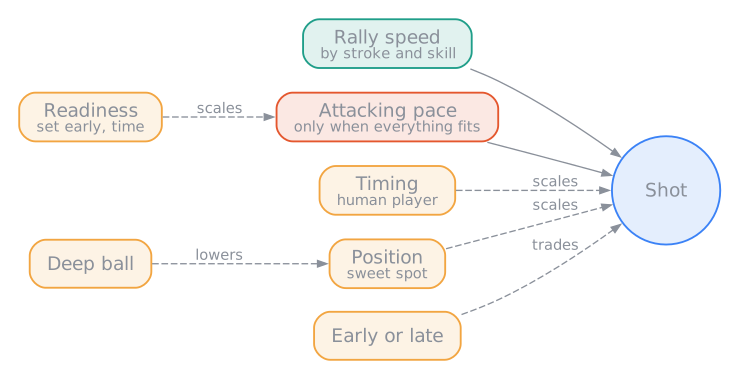
Shot speed
| Stroke | Rally speed | Extra attacking pace |
|---|---|---|
| Forehand | 33–38 m/s (119–137 km/h) | 10–14 m/s |
| Backhand | 31.5–36 m/s | 8–12 m/s |
| Slice | 22–26 m/s | 4 m/s |
| Drop shot | 9–13 m/s | none |
| Volley | 14–18 m/s plus 55% of the incoming ball’s speed | 6 m/s on a high ball |
The ranges go from the weakest to the best player at that stroke. For example, a perfect forehand of the best player reaches about 52 m/s (187 km/h). The rally speeds come from Hawk-Eye tracking of the Australian Open: a pro’s rally ball leaves the racket at about 125–130 km/h, crosses the net about 0.55 m above the cord and peaks at about 1.7 m.
Timing (human player)
Releasing the shot button is the moment of truth. The timing quality is 1 inside the perfect window just before contact and falls to 0 when the button is released 0.8 s or more too early. The perfect window is 0.12 s for an average player. The player’s timing stat widens or narrows it (from 75% to 135%), and taking the ball early or late changes it too (see below).
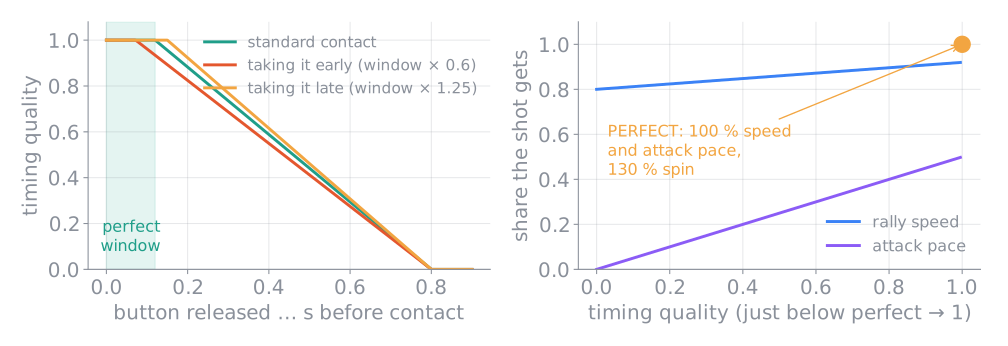
Perfect timing is its own tier. Compare a release just outside the window with a perfect one:
| Worst timing | Just outside perfect | Perfect | |
|---|---|---|---|
| Rally speed | 80% | 92% | 100% |
| Attacking pace | 0% | 50% | 100% |
| Spin | 85% | 105% | 130% |
| Landing area radius | 2.5 m | 0.9 m | 0.25 m |
The landing area is then scaled by the player’s precision: shot control, mixed with the return skill for a return of serve and the net game for a volley. Pressure reduces shot control (see Pressure and confidence).
Still holding the button when the racket meets the ball means the player just blocks the ball back: a weak shot through the middle that lands about 6 m behind the net at 70–90 km/h.
The AI has no button to time. Its precision comes from its stats and play style instead.
Position: the sweet spot
Every stroke animation has a contact point: where the racket meets the ball in that swing. The closer the real ball passes to it, the cleaner the hit.
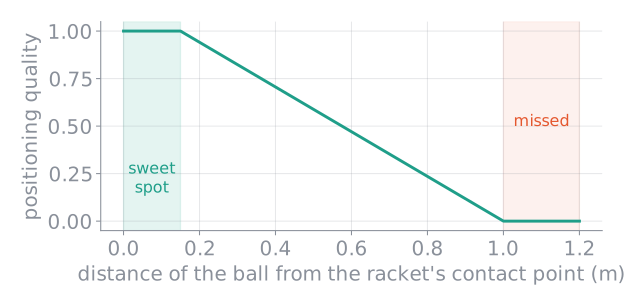
A ball met off the sweet spot loses control. Less control means less of the attacking pace, a shorter and flatter ball (down to 55% of the planned depth and 35% of the spin), and a bigger random miss (up to 3 m).
Readiness
The full attacking pace needs a ready player:
- Set early: the player was standing (moving slower than 1 m/s) for at least 0.5 s before contact.
- Time from the ball: a ball that reaches the player within 0.75 s of being hit (a hard drive or serve) leaves no time to attack; from 1.35 s on, there is plenty.
The worse of the two counts. So a hard ball can be returned, but not attacked.
Deep balls
A ball bouncing near the baseline pushes the player back and rushes the shot. From 8 m behind the net to the baseline the pressure rises from nothing to full. A fully deep ball takes away 35–60% of the control (less for players with good shot control) and all of the attacking pace. For a serve, the same happens over the last 2.5 m before the service line.
Fast balls
A fast ball is hard to control. A rally ball arrives at about 10–14 m/s; from 13 m/s on, the pace takes away control, at 20 m/s (a hard first serve) 35–70% of it (less for precise players, and on a return for good returners). So a big serve usually gets a weak return back: shorter, slower and more scattered.
Early or late: the contact window
After the bounce, the ball can be met anywhere in a contact window:
- the early end, on the rise at 0.8 m;
- the standard contact, as the ball drops through 1.1 m after the top of its bounce (or at the top, for a low bounce);
- the late end, as it drops to 0.5 m.
A player only moves back about a meter for a normal groundstroke, so the window ends where they would have to move back further. A deep, high ball is then taken earlier and higher.
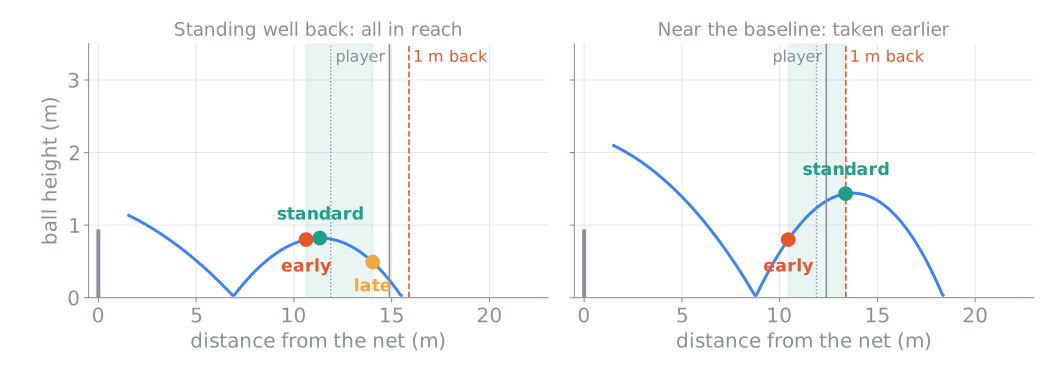
The earliness of a contact is 1 at the early end, 0.5 at the standard contact and 0 at the late end. It changes the shot:
| Early | Late | |
|---|---|---|
| Pace | borrows up to 15% of the incoming ball’s speed | keeps only half of the attacking pace |
| Risk | up to 30% less control (half for the best timing) | none |
| Timing window (human) | down to 60% | up to 125% |
A human player chooses by where they stand: once the shot button is pressed, the player meets the ball at the point of the window closest to them. The AI chooses by its play style (see The AI opponent).
Serves
A serve’s speed depends on serve power (47–58 m/s, 169–209 km/h, for a flat first serve). A slice serve has 87.5% and a kick serve 76% of that speed, traded for spin. Second serves are slower. For a human player, the serve’s timing works like a shot’s, with a perfect window of 0.08 s: an untimed serve keeps 72% of its speed, a perfect one all of it.
scenes/player/player.gd (contact: position, readiness, deep and fast balls, earliness),
scenes/player/controllers/human_controller.gd (timing, aiming, charging),
scenes/player/contact_window.gd (the contact window),
scenes/player/controllers/controller.gd (choosing the contact point),
scenes/player/ai/shot_executor.gd (the AI’s shots).