Ball physics
Short version: the ball is pulled down by gravity, slowed by the air and pushed up or down by its spin. When it lands, it bounces back up with less speed; topspin makes it kick forward and higher, backspin keeps it low. It can clip the net cord and dribble over, or run into the net. The game computes all of this itself, step by step, so it can also predict where a ball will go.
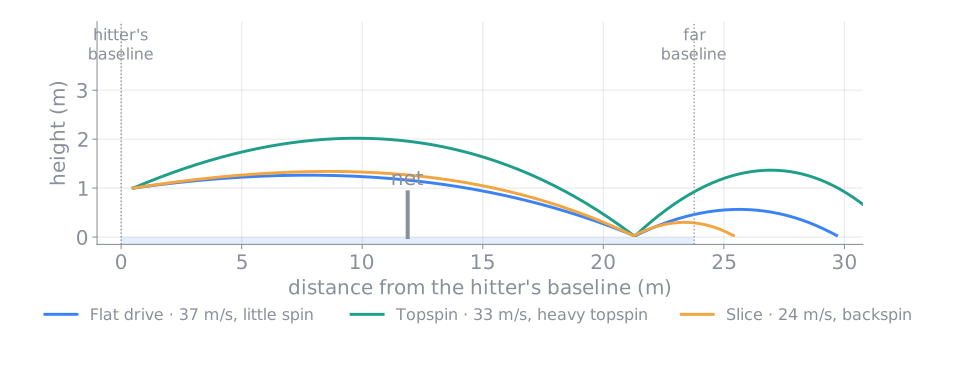
Forces in flight
Every physics step (about 60 times per second, and 240 times per second when the game works out how to aim a shot), the ball’s velocity changes by:
- Gravity: 9.81 m/s² downward.
- Spin, which acts more on a fast ball than on a slow one:
- topspin pushes the ball down, up to 15 m/s² at full spin, so it dips into the court;
- backspin pushes it up, up to 12 m/s². This lift carries a slow slice: hit above the net it flies almost straight, hit below the net it is lifted over the cord, and it floats down as it slows;
- sidespin curves the ball sideways, up to 8 m/s².
- Air drag, which slows the ball the more the faster it is.
In formulas, with spin between −1 and 1 and the speed factor :
where is 15 m/s² for topspin and 12 m/s² for backspin, and .
The bounce
When the ball reaches the ground:
- It keeps 60–78% of its downward speed, going back up. A gentle impact keeps more than a hard one, like a real ball.
- It keeps 60% of its forward speed (friction: a hard court grips the ball). With this the ball takes about as long from stroke to stroke as in Hawk-Eye tracking of the Australian Open (about 1.3 s), and comes up to about 1 m after the bounce.
- Topspin kicks it forward and a little higher; backspin holds it back and keeps it low; sidespin kicks it sideways.
- The ball keeps 60% of its spin.
A ball that lands very softly (slower than 0.6 m/s downward) does not bounce anymore. It rolls and slows down.
The net
The net cord hangs from 1.07 m at the posts of the singles net, inside the doubles alleys, to 0.914 m in the middle. When the ball crosses the net:
- Above the cord: nothing happens.
- Just touching the cord: it pops up a little, loses about half its speed and dribbles over. On a serve that lands in, this is a let and the serve is replayed.
- Into the net: it drops back on the hitter’s side.
Predicting the flight
Because the game runs the same steps for the real ball and for a prediction, the predicted flight matches the real one to within a few centimeters. The prediction is a list of points, each with a position, a time and how many times the ball has bounced since it was hit. Everything that needs to know the future uses it:
- the players, to find where and when to meet the ball;
- the swing, to start the animation so the racket arrives at the right moment;
- the AI, to judge how deep and how high a ball comes.
Aiming: how a shot finds its target
A player decides where the ball should land and how fast it should go forward. The game then finds the rest:
- Guess a sideways and an upward speed.
- Simulate the flight and see where the ball lands.
- Correct the sideways speed by the sideways miss, and the upward speed by the depth miss.
- Repeat until the ball lands within 3 cm of the target (at most 12 times).
Then it checks the net: if the ball would pass lower than the wanted clearance over the cord (15 cm for groundstrokes, 3 cm for serves), the shot is hit 10% slower, which means a higher and safer arc, and solved again. A real player does the same thing when a ball is too low to drive flat.
scenes/ball/ball.gd: flight (_advance_velocity), bounce (_touch_ground),
net (_collide_with_net), prediction (predict_trajectory) and aiming (calculate_velocity).
The plot above is drawn by tools/plots/make_plots.py in this documentation, which repeats the
same formulas.