The AI opponent
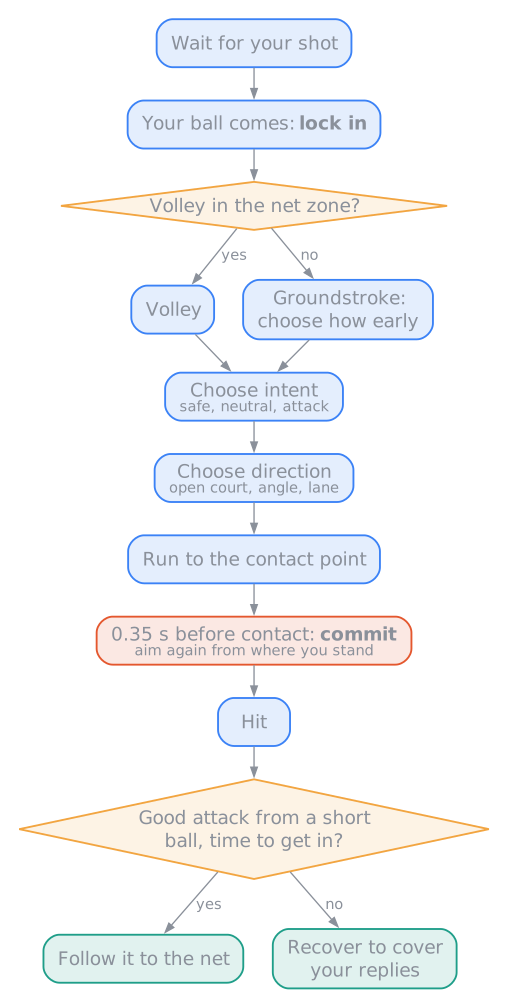
Short version: when your ball comes, the AI reacts after 0.28 s, predicts its flight and decides where to meet it. It decides how bold to be (safe, neutral or attacking) and in which direction to play, looking at where you stand. It looks at you once more just before it swings. After hitting, it recovers to the spot that best covers your possible replies, or, after a good attack from a short ball, follows it to the net. It plays by the same rules as you: the same physics, the same movement, the same shot model.
Reacting
Like a real player, the AI cannot move the instant you hit: it needs 0.28 s to react to your shot (a pro returner’s first step comes about 0.25–0.3 s after the serve). In a rally that is plenty of time; against a fast serve away from it, it may not get there: an ace.
Where to meet the ball
For a groundstroke, the AI picks a point in the contact window:
- By play style: an aggressive player takes the ball earlier (earliness 0.3 for the least, 0.75 for the most aggressive), with some random variation from ball to ball.
- A short ball is taken early, inside the court, so the AI can attack it.
How bold: safe, neutral or attack
| The AI plays safe when… | It attacks more often when… |
|---|---|
| it barely gets to the ball (needs more than 120% of the available time, counted from a standstill) | the ball is a chance: short (bounces nearer than 7.5 m from the net) and weak (slower than 27 m/s) |
| your ball is very fast (over 42 m/s, 151 km/h, about the fastest tenth of pro rally balls) | you are out of position |
| it is exhausted (below 32% stamina) | its play style is aggressive (15% to 45% base chance) |
| Never on a ball met low near the net (below 0.5 m inside the service line, like a drop shot): it has to be lifted over the net | |
| your ball is deep (up to half the time, the deeper the more) |
On a full chance (a short, weak ball), it attacks about 90% of the time.
Where to: watching you
The AI works out where you should stand to cover its shot: a little toward the side it hits from, the middle of the angles it can play. The farther you are from that spot, the more out of position you are, and the more it plays into the open court, away from you.
With a short ball and you in position, it often plays a short angle: cross court, wide and short with extra topspin, to pull you out of the court. Then the next ball goes into the open court on the other side.
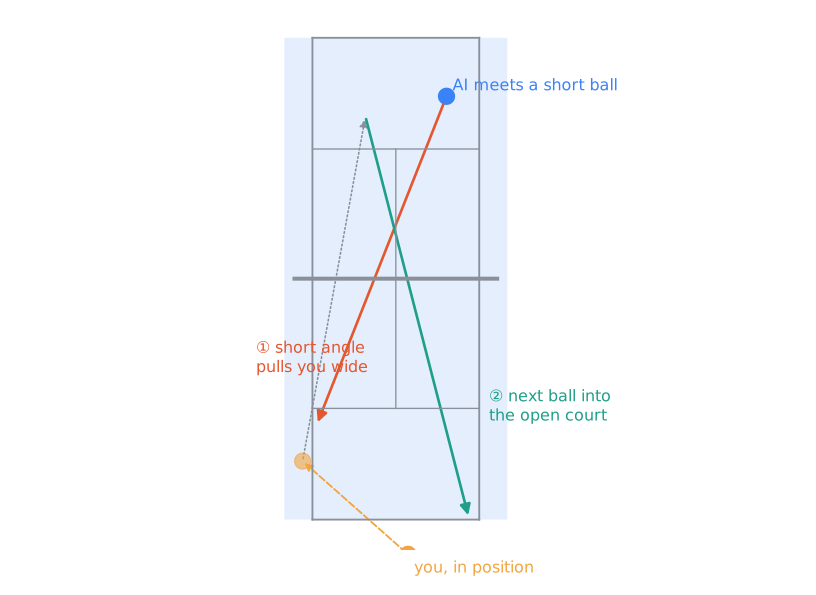
Otherwise it picks between cross court, center and down the line: cross court (over the low middle of the net, into the longest diagonal) is the safe default, down the line the aggressive one. Its play style shifts these odds, and some players have a favorite pattern (always cross, or inside-out forehands).
Committing late: the AI decides on a target when your ball comes, but 0.35 s before contact it looks at you again and re-aims. Running to one side too early can be punished.
Volleys and the net
The AI volleys when it plays at the net, or when your ball comes into the net zone (within 6 m of the net) out of the air and it can step in and be set in time. It does not volley balls higher than 2.3 m; those it lets bounce.
It follows its own shot to the net only when all of these hold:
- it attacked from at least 1.5 m inside the baseline (after a short ball),
- the ball was met cleanly and lands deep or wide, and is fast or leaves you stretched,
- it can reach the service line before you hit your reply, so it can volley from there instead of being passed in the middle of the court,
- and it decides to (15% to 55% of the time, by its net play skill).
If it then has to play a groundstroke anyway (say, you lob it), it gives up the net.
Recovering
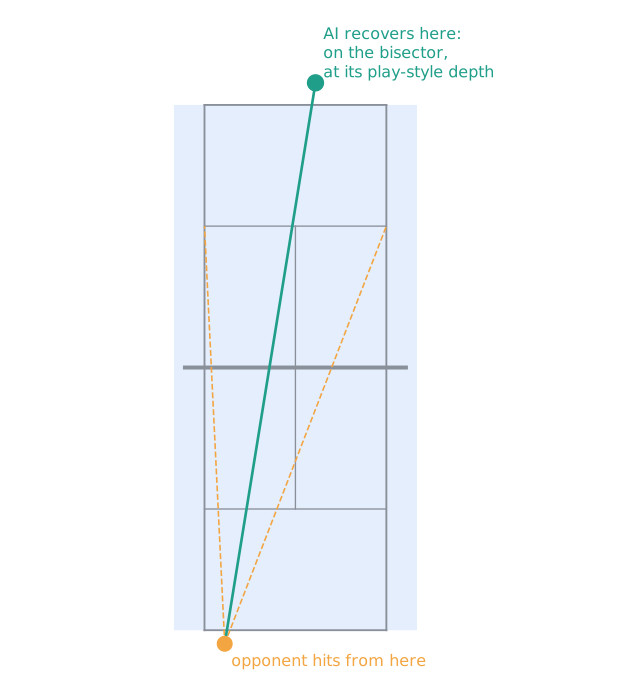
After hitting, the AI recovers onto the bisector of the angle you can play into: from your hitting position, halfway between the two corners of its service line. How deep depends on its play style (from 1.5 m inside to 2.3 m behind its usual spot, 1 m behind the baseline). After a weak shot of its own it stays 0.6 m deeper; after a good attack it steps 0.9 m in. It jogs back at 70% of its top speed instead of sprinting, so, like a pro in Hawk-Eye tracking, it is often still on its way when you hit. A ball into the space it is leaving is hard to get.
What makes AI players different
Each player has a play style:
| Style value | Effect |
|---|---|
| Aggression | How often it attacks, how early it takes the ball, how often down the line |
| Shot power | Pace of its rally shots |
| Topspin | How much topspin it uses (more margin over the net) |
| Court position | How deep it stays: inside, on, or well behind the baseline |
| Consistency | How tightly its shots group around the target |
| Preferred pattern | A favorite tactic, which makes players recognizable |
…and the same stats as any player (see Stamina and player stats). Its shots miss their target by a random, normally distributed amount: most land close to the target, a few far off. The spread is larger for a less precise player, for an attacking shot and for a hard ball (fast, deep, or one it barely gets to), and smaller for a safe shot. It is tuned to Hawk-Eye tracking of the Australian Open: about 15% of rally shots miss, more of them long than wide, a few into the net. Its serves aim at the T, the body or wide, a first serve close to the lines (the more precise the server, the closer; about a third are faults), a second serve with more margin (about 7% are faults).
Compared with real tennis
The ball physics and the AI are tuned to Hawk-Eye tracking of the men’s singles at the Australian Open. In AI-against-AI matches:
| Pelota | Hawk-Eye | |
|---|---|---|
| Rally ball over the net cord | 0.46 m | 0.56 m |
| Rally ball apex | 1.74 m | 1.68 m |
| Contact height | 0.92 m | 0.95 m |
| Lands inside the baseline | 4.2 m | 3.7 m |
| Speed off the racket | 125 km/h | ~125–130 km/h |
| Time from stroke to stroke | 1.28 s | 1.28 s |
| Rally shots landing in | 85% | 85% |
| First serve faults | 34% | 36% |
| Second serve faults | 6.5% | ~7% |
| Aces (share of points) | 6.5% | 7% |
| Points won by the server | 56% | 62% |
(Medians; the Pelota values come from about 325 points between AI players.)
scenes/player/controllers/ai_controller.gd (phases, where to meet the ball,
commit, net approach, recovery), scenes/player/ai/ai_point_context.gd (chance, out of
position), scenes/player/ai/shot_planner.gd (intent and direction),
scenes/player/ai/shot_executor.gd (building the stroke),
scenes/player/resources/ai_play_style.gd (play styles).